Cooped up indoors, self-isolating? There’s a reason you don’t feel well
Advertisement
Experiences
Cooped upwardly indoors, self-isolating? In that location's a reason you don't feel well
If yous don't have enough contact with the natural world, there can be emotional and physical costs. But you tin can reduce stress by bringing the natural world inside.

Don't simply put a single orchid in the corner; instead, try a grouping of plants, as the biophilic design business firm Greenery NYC did here. (Photo: Brad Dickson)
When you spend a lot of time indoors, as many of us are doing now, information technology's easy to succumb to a sense of malaise. Scientists, architects and others who study the concept of biophilic blueprint – creating buildings and interiors with cues from the natural world – say there's a reason for that.
"Humans have an affinity toward nature that's biologically embedded," said Bethany Borel, a senior associate at CookFox Architects, which has designed numerous offices with biophilic elements, including its own studio in Manhattan. If you don't accept enough contact with the natural world, Borel said, there can exist emotional and physical costs.
Biophilic design attempts to counter this past connecting people with nature, which "can help reduce stress, improve cerebral performance, elevate our mood and have various physiological benefits," said Bill Browning, a founder of Terrapin Bright Light-green, a New York-based sustainability consulting firm established in 2006 with the founders of CookFox.
READ> The architects designing the Punggol Digital District on creating a greener Singapore
A contempo written report past researchers at the Harvard T.H. Chan School of Public Health, published in the journal Environment International, supported that claim, terminal that biophilic interiors helped inhabitants recover from stress and reduce feet more than speedily than interiors without natural elements, and documented a notable reduction in claret pressure.
So how tin can this help you survive an extended lockdown? We asked architects and designers for tips on how to incorporate biophilic design at home.
READ> Keep your spirits up, raise your well-existence – by giving your abode a makeover
BRING IN THE HOUSEPLANTS
One of the most straightforward ways to add nature to a space is with houseplants. Only don't just put a single orchid in the corner. Instead, try a little grouping of plants.
"We respond differently to a group of plants together," Browning said. "Environmental psychologists are theorising that when we run into a cluster of plants together, the brain says, 'Oh, wait, at that place's a habitat, and then this must exist a good identify for me to be.'"
It doesn't have to take upwards a lot of space: A few types of plants could exist installed together in a terrarium.
Or, "if you lot've got one big potted found, create an understory," he suggested, with a small plant spilling over the side of the pot. That way "information technology becomes a miniature landscape."
"Ecology psychologists are theorising that when nosotros see a cluster of plants together, the brain says, 'Oh, look, there's a habitat, so this must exist a good identify for me to exist.'" – Neb Browning
READ> Raising the roof: Cultivating Singapore'due south urban farming scene
Just Avoid Additional STRESS
Those of us who take a checkered history with houseplants should offset slowly and choose plants that are piece of cake to maintain.
"Sometimes, having a lot of houseplants around can actually make y'all feel broken-hearted about taking care of them," said Rebecca Bullene, a partner at the biophilic pattern house Greenery NYC, which operates Greenery Unlimited, a plant store in Greenpoint, Brooklyn. "If y'all're killing plants all the time, information technology tin brand you lot feel actually lamentable."
But no worries: "There are a handful of plants that are relatively foolproof," said Adam Besheer, Bullene's partner at Greenery NYC. That includes ZZ plants (Zamioculcas zamiifolia), snake plants, pothos, Philodendron cordatum and aglaonema.
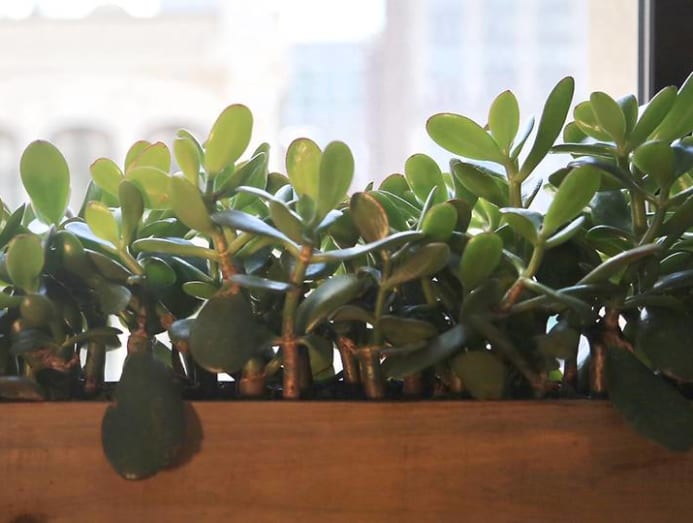
Clodagh, a New York-based interior designer who employs biophilic pattern principles in her projects, often uses jade plants for their simplicity. "In our own function, we have about 20m of window boxes filled with jade plants," she said. "It's very, very like shooting fish in a barrel and helps clean the air."
To increment your chances of success, Besheer said, make sure you know how much water your chosen plants crave over time, and that your planters have proper drainage holes. If your domicile doesn't get a lot of sunlight, purchase a elementary full-spectrum LED retrofit calorie-free seedling for a lamp, to serve equally a abound calorie-free.
CREATE AN ALTERNATIVE VISUAL Connectedness TO NATURE
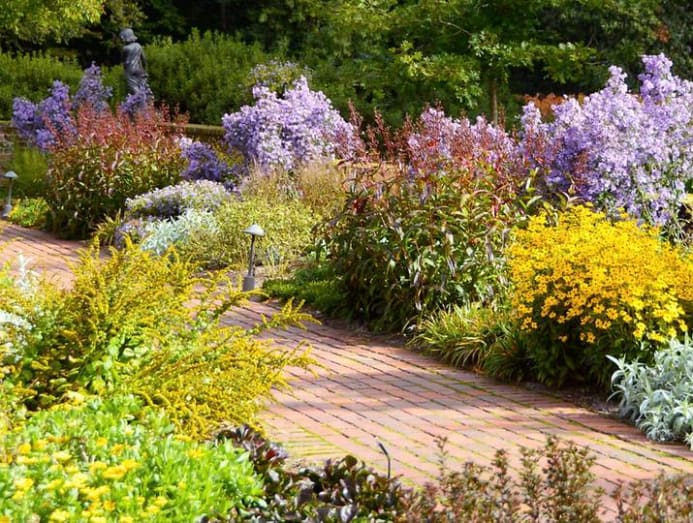
Indoor plants aren't the only manner to create a visual connection to nature. If you accept a terrace or balcony, greenery exterior the window works well. Or, you may be able to capture views of a park or tree downwards the street.
"We'll use mirrors to bring positive views within," said Clodagh. "If there's a tree, we'll use a mirror to bring a view of that tree inside."
Dried flowers are another option. Michael Hsu, an architect in Texas, commissioned a ceiling-mounted installation of dried flowers from the floral design studio Davy Gray when he recently opened an office in Houston.
"I call it a flower deject," Hsu said. "Yous see a lot of green walls in offices right now, but they accept their own challenges with lighting and h2o. This is easier to maintain, merely still changes the mood of the briefing room."
Photographs of natural scenes tin also do the fob, Borel said: "Even if it'southward not an actual beach that you meet out your window, it has a calming result and helps to drop your cortisol levels down a niggling bit."
Add together NATURAL MATERIALS AND PATTERNS
Adding finishes, furniture and accessories made from natural materials – woods with an appealing grain pattern, for example, or natural stone – can evoke nature, also.
"Nosotros try to use natural materials with the least amount of processing possible," Hsu said. "It's the architectural equivalent of eating organic nutrient. With woods, we desire to celebrate the grain and grapheme of each species. It does then much for us, emotionally."
Part of the appeal is the tactile nature of those materials.

"When I'g sitting at a table that has a live edge, or some kind of articulation to the woods grain, I end up running my fingers over the border of the table," Borel said. "That hidden connexion with the natural helps u.s. calm down a trivial."
Manufactured products like carpets, wallcoverings and fabrics that mimic patterns establish in nature can have a similar effect.
"Retrieve of the love locusts in Paley Park that create the amazing dappled light in that infinite, or the pattern of the water on the waterfall," Browning said of the Manhattan dark-green space. "Those are statistical fractals."
When fractals like those are used as decorative patterns on the things that surround us, he said, "the firsthand response you see is a reduction in stress."
CONSIDER THE LIGHT
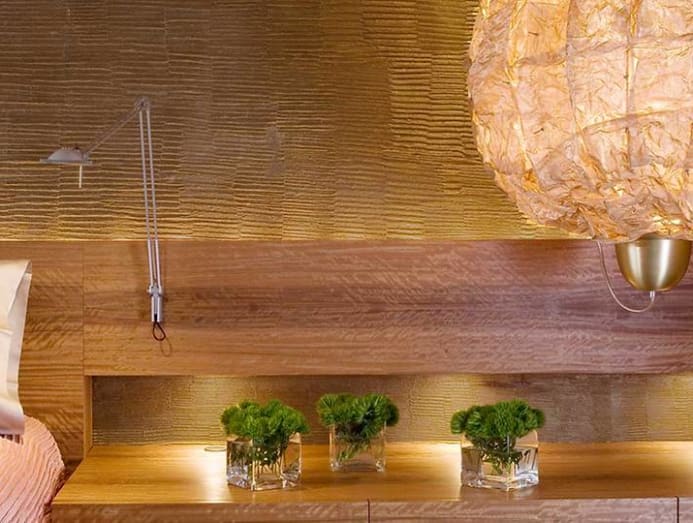
If your home doesn't get a lot of natural light, consider adding lamps and light bulbs that provide various color temperatures and intensities over the course of the solar day to help continue your body'due south circadian system in bank check.
"People tend to gravitate to windows because you lot see the light alter throughout the day," Borel said.
"Every bit humans, nosotros have a wheel that is dependent on the natural lighting in our environment: Blue morning time calorie-free helps us wake upwards and feel energised," she said, while the gentle, warm light of the setting sun helps prepare us for sleep.
If your home has a lot of static artificial light, it may be worth investing in adjustable bulbs, Borel said, from companies like Ikea and Philips, which brand affordable options. At CookFox's part, she said, the architects use Koncept Lady7 task lamps to change betwixt absurd and warm white light at their desks.
INSTALL A FOUNTAIN
H2o – in the form of an aquarium or a small fountain – can be another powerful reminder of nature.
"The sound of water is clinically proven to aid yous relax," said Clodagh, who often includes h2o features in her projects, from private residences to apartment lobbies. "Any kind of moving water is terrific."
The sound may likewise help block out distracting noises, like traffic or screaming children.
"A small fountain, little waterfall or small, gurgling stream is by far the most effective acoustic masking audio," Browning said. "The encephalon will focus on that and filter out almost of the conversations or other noise in a infinite."
And it doesn't accept to exist complicated or elaborate, Clodagh noted: "Yous can put a bubbler in a large steel dog bowl, with some pots of greens around it, and have your indoor garden."
"The audio of h2o is clinically proven to assist you relax. Whatsoever kind of moving water is terrific." – Clodagh
Discover A CAVELIKE REFUGE
Fifty-fifty with a broad assortment of natural elements, yous may even so experience the need to retreat from roommates or family unit members, like an ancient hunter-gatherer returning to a cave. If so, try to identify a cosy place where your back is protected, preferably somewhere with a low ceiling, Browning said.
In most homes, he noted, "that'due south the window seat, the wingback chair or the four-affiche bed – it's just that piffling space where y'all can tuck in for a intermission."
By Tim McKeough © 2022 The New York Times
READ> Singapore is becoming a nation of urban gardeners – but is it all that sustainable?

Recent Searches
Trending Topics
Source: https://cnalifestyle.channelnewsasia.com/experiences/cooped-up-indoors-not-feeling-well-251256
0 Response to "Cooped up indoors, self-isolating? There’s a reason you don’t feel well"
Postar um comentário