My Westie Puppy s Ears Stood Up and Now They re Floppy Again Why
Why Do Pets Take Floppy Ears?
This article was originally published at The Conversation. The publication contributed the article to Live Science's Skillful Voices: Op-Ed & Insights.
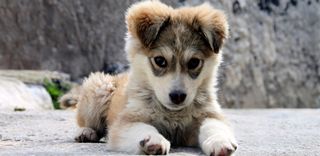
Accept a look at several domesticated mammal species and y'all might spot a number of similarities between them, including those cute floppy ears.
The famous naturalist and evolutionary theorist Charles Darwin even observed in the showtime chapter of his On the Origin of Species that:
Not a single domestic animal tin be named which has not in some country drooping ears […]
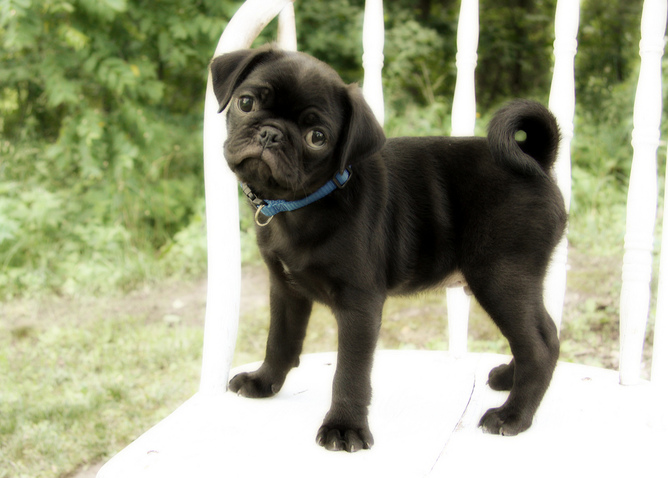
And information technology'southward not just the ears. Domesticated animals share a fairly consequent set of differences from their wild ancestors such as smaller brains, smaller teeth, shorter curly tails and lighter and blotchy coats: a miracle called the "domestication syndrome".
A newspaper published this calendar week in the journal Genetics poses a new caption every bit to why so many domesticated animals take such a like set of traits.
Adam Wilkins, from S Africa's Stellenbosch Institute of Avant-garde Study, and colleagues propose that human being selection has, in domesticated species, altered the development of the neural crest, an organ arrangement present during embryonic development.
The silver fox experiment
The dog has been befriended past humans for at least eleven,000 years, longer than any other domesticated brute. They differ from their wild ancestor wolves in all the above listed features of domestication syndrome.
Dogs aren't the just examples, of grade. Humans have also domesticated cattle, horses, sheep, goats … the list goes on.
In the belatedly 1950s, Russian fox-fur-farmer-turned-geneticist Dmitry Belyaev set up a long-term experiment to discover out whether he could selectively brood the wildness out of the silver play a joke on, which was hard to breed because of its aggressive nature.
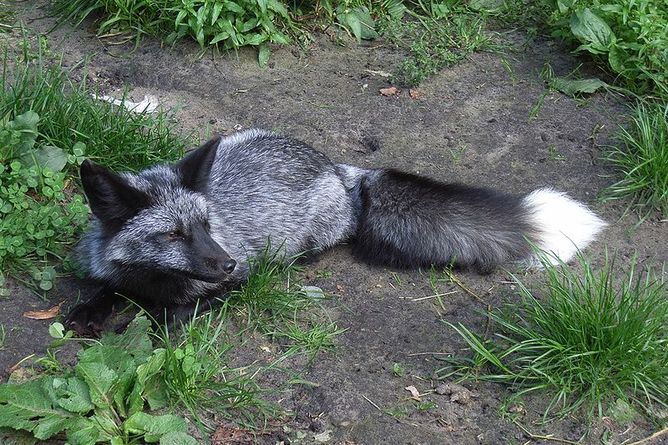
In each generation of foxes, he bred from animals that showed the least aggression towards their captors.
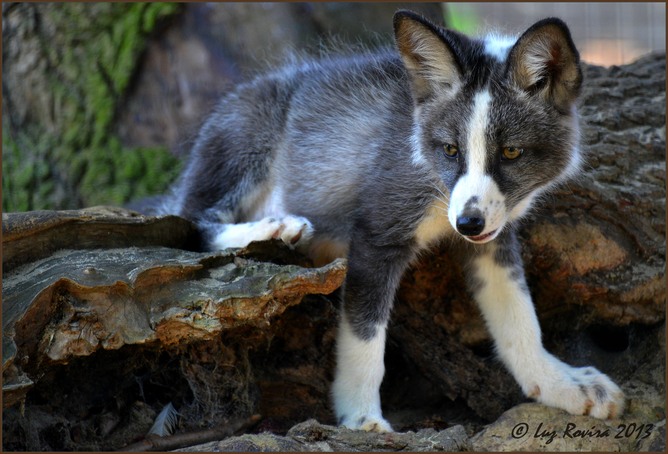
It took him and his successor Lyudmilla Trut just xx generations – merely near 25 years – to create a line of silver foxes who from nascence were tame plenty to exist kept every bit pets. For those who study evolution, this is an extraordinarily brusk fourth dimension span.
Simply that wasn't the most surprising result. Although selected only for their temperament, the later generations of silver foxes as well had shorter faces, smaller teeth, soft and droopy ears, curly tails and contradistinct colour.
Humans might selectively breed for less "flighty" and less "fighty" beasts, but why should domesticated animals also testify characteristic changes in other body features?
The neural crest
In 1868, the same yr that Darwin published an entire monograph on domestication, Swiss anatomist Wilhelm His Sr described what became known every bit the embryonic neural crest.
Vertebrate embryos at an early stage of evolution consist of three "germ layers". He described a strip of cells in the outer layer (ectoderm), between the role that produces skin and the part that produces the central nervous system, and named this the Zwischenstrang ("between-strand"). It's now chosen the neural crest.
These cells migrate into the middle layer (mesoderm), which produces skeletal, connective, muscular, glandular and reproductive tissues.
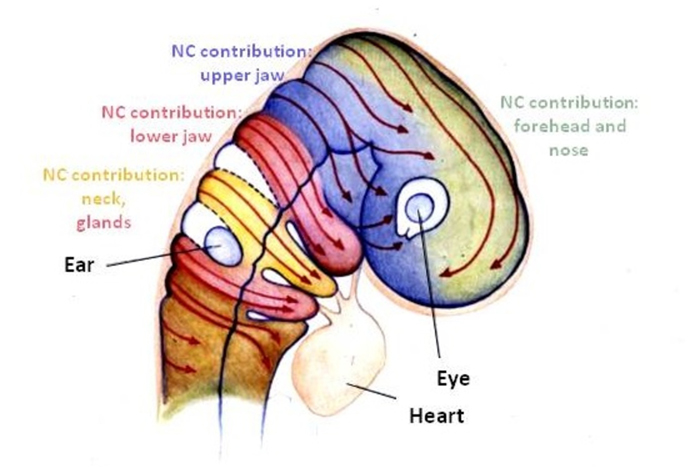
Each germ layer was thought to produce mutually-exclusive tissues, simply the bombshell came 20 years later when Russian biologist Nikolai Kastschenko proposed that archetypal heart layer tissues such as the craniofacial skeleton originated in the neural crest.
Information technology took more than 30 years before Kastschenko'southward heretical observations were accustomed.
Explaining domestication syndrome
Wilkins and colleagues now suggest a hypothesis that links the development of the neural crest with the body changes that accompany domestication.
The neural crest produces non but facial skeletal and connective tissues, teeth and external ears but also pigment cells, nerves and adrenal glands, which mediate the "fight or flight" response.
Neural crest cells are likewise important for stimulating the evolution of parts of the forebrain and for several hormonal glands.
The researchers argue that the domestication process selects for pre-existing variants in a number of genes that affect neural crest evolution. This causes a modest reduction in neural crest cell number or activity. This in plough affects the wide range of structures derived from the neural crest, giving rise to domestication syndrome.
Interestingly, deleterious alterations in genes decision-making neural crest development cause wide-ranging syndromes called neurocristopathies in humans and in animals.
The researchers bolster their argument using several examples including Treacher Collins, Mowat-Wilson and Waardenburg syndromes. Indeed, they suggest that the domestication syndrome resembles a mild multi-gene neurocristopathy.
Surprisingly, they fail to include Williams Syndrome, which allies a mild variation in facial evolution with an unusually friendly disposition, every bit illustrated in the last year'south French-Canadian film Gabrielle.
The genetic region associated with Williams syndrome has been identified as one of the many regions in the canine genome that varies genetically between dogs and their wild ancestors, wolves.
This new hypothesis proposes 1 intriguing respond to the domestication question originally identified by Darwin and illustrated by Belyaev and Trut: why do all the traits of domestication co-be in multiple species?
It may exist that neural crest contributions are and then various that it's possible to cerise-pick points of congruence to support whatsoever hypothesis. Nonetheless, the researchers advise several lines of molecular genetic and functional experiments that can farther put their ideas to the test.
Don Newgreen receives funding from National Wellness & Medical Research Quango, Stem Cells Australia and Fiscal Markets Foundation for Children.
Jeffrey Craig receives funding from the National Health and Medical Research Council, the Fiscal Markets Foundation For Children and the Jack Brockhoff Foundation
This article was originally published on The Chat. Read the original commodity. Follow all of the Adept Voices issues and debates — and become part of the discussion — on Facebook, Twitter and Google +. The views expressed are those of the author and do not necessarily reverberate the views of the publisher. This version of the article was originally published on Live Science.
Source: https://www.livescience.com/46822-why-do-pets-have-floppy-ears.html
0 Response to "My Westie Puppy s Ears Stood Up and Now They re Floppy Again Why"
Postar um comentário